Concrete Driveway Thickness 101
If you’re planning a new driveway in Harrisburg or anywhere in Central Pennsylvania, thickness is one of the first questions to settle. It’s also one of the questions we hear most at RJL Concrete Service. The short answer is 6 inches for most homes. However, the right thickness depends on what you’ll park on it and what’s underneath it.
How Thick Should a Concrete Driveway Be?
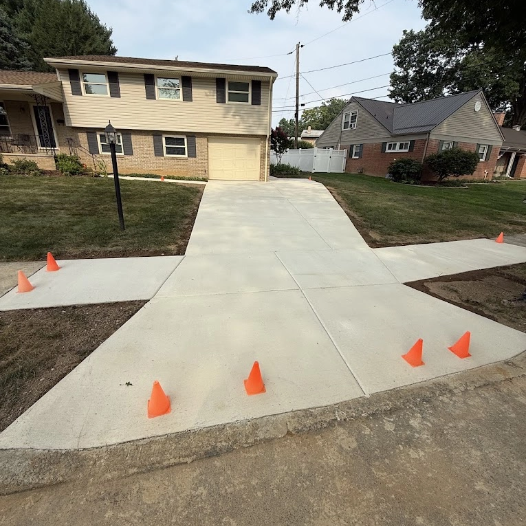
A typical residential concrete driveway in Central PA should be 6 inches thick, poured over a properly compacted aggregate base. If the driveway will regularly carry campers, large trucks, or heavy equipment, plan for 7 to 8 inches.
“The correct thickness should be based on the expected loads, soil conditions, drainage, and project requirements,” says Rashaun of RJL Concrete Service. In other words, 6 inches is a starting point, not a rule for every driveway.
What’s Under the Concrete Matters Just as Much
A driveway is only as strong as its foundation. At RJL, we start with a properly prepared and compacted subgrade, which is the native soil. Next, we add about 4 inches of compacted aggregate base, adjusted for the soil on your property. Then we use mechanical compaction to create a firm, uniform surface for the concrete.
Where it fits the job, we also add welded wire reinforcement. “Reinforcement does not eliminate cracking,” Rashaun explains, “but when properly supported and placed, it can help control crack width.”
Why 6 Inches Matters
The extra 2 inches over a standard sidewalk serves a purpose:
-
Vehicle weight:
Cars, SUVs, and delivery vans put concentrated loads on concrete. A thicker slab spreads that weight over more of the base.
-
Crack resistance:
Thicker concrete is better able to resist bending and settling over soft spots.
-
Longer life:
A slab sized for its loads holds up better through decades of daily use and Pennsylvania winters.
What Happens When a Driveway Is Poured Too Thin?
According to Rashaun, thin concrete is only part of the story. “One of the biggest problems we see is poor or insufficient subbase preparation,” he says. “If the subgrade isn’t properly prepared and the aggregate base isn’t adequately placed and compacted, the slab can settle and crack.”
Watch for these signs of an under-built driveway:
- Spiderweb or random cracking across the slab
- Sunken or tilted sections
- Broken or crumbling edges
- Cracks that don’t follow the control joints
That last point is important. Control joints are the planned grooves in the concrete. “Proper jointing gives the concrete designated locations for contraction cracking,” Rashaun notes. When joints are missing or poorly placed, the concrete cracks wherever it wants.
Central PA’s Freeze-Thaw Climate and Your Driveway
Central Pennsylvania has four true seasons, and that’s hard on concrete. In winter, temperatures often swing above and below freezing. Water soaks into the concrete, freezes, expands, and thaws again. Over time, these freeze-thaw cycles can cause scaling (flaking at the surface) and cracking.
That’s why RJL focuses on what Rashaun calls the full picture: “Proper mix selection, air entrainment for freeze-thaw exposure, finishing, curing, drainage, jointing, and responsible use of deicing materials are all important, especially during the first few winters.” Air-entrained concrete contains tiny air bubbles that give freezing water room to expand without damaging the slab.
Which De-Icers Are Safe for Concrete Driveways?
De-icing salts can damage exterior concrete, especially when the concrete stays wet and repeatedly freezes and thaws. Follow these guidelines:
- First winter: Skip de-icers on new concrete. Use plain sand for traction instead.
- After the first winter: Use rock salt (sodium chloride) or calcium chloride sparingly and follow the label directions.
- Never use: Products containing ammonium nitrate or ammonium sulfate. These chemicals, often found in fertilizers, attack concrete. The Pennsylvania Aggregates & Concrete Association also warns against magnesium chloride and other magnesium-based products.
- Always: Shovel early so you need less product, and clear away slush once the ice melts.
Concrete vs. Asphalt Driveways in Central PA
| Factor | Concrete | Asphalt |
|---|---|---|
| Upfront Cost | Higher | Lower |
| Lifespan | Longer With Proper | Shorter |
| Maintenance | Occasional sealing and joint care | Regular sealcoating and patching |
| Summer Heat | Stays firm and cooler | Can soften and get hot |
| Winter | Needs careful de-icer use | Handles salt better, but cracks and potholes form |
| Curb Appeal | Many finish and color options | Plain black surface |
Asphalt costs less upfront. On the other hand, a well-built concrete driveway typically lasts longer and needs less ongoing upkeep.
Tips to Extend the Life of Your Concrete Driveway
- Seal the surface periodically to help keep water and salt out.
- Shovel snow promptly so ice doesn’t bond to the surface.
- Keep heavy equipment and dumpsters off the edges.
- Direct downspouts and runoff away from the slab.
- Seal or fill joint and crack openings early.
- Keep fertilizer off the concrete.
Do Central PA Townships Set Driveway Standards?
Many do, especially for the driveway apron where it crosses a public sidewalk. For example, some Pennsylvania townships require 6 inches of concrete with steel mesh at the apron, and some boroughs require 8 inches for commercial aprons.
Before you build: Requirements vary by township and borough. Always check with your local municipality about permits, ordinances, and construction standards. RJL can help you understand what applies to your project.
Get a Free Driveway Estimate
At RJL Concrete Service, we price driveways based on what the concrete actually needs, not by cutting thickness or base prep to win a bid. Call 717-686-2482 or request your free estimate online today!
About RJL Concrete Service:
Rashaun Hill is the owner and operator of RJL Concrete Service, a locally owned and operated concrete contractor serving Harrisburg and Central Pennsylvania. For the past 9 years, Rashaun has specialized in residential, commercial, and industrial concrete. His work includes driveways, sidewalks, patios, steps, foundations, and garage floors, as well as parking lots, loading docks, dumpster pads, and ADA-compliant sidewalks and ramps.
On every job, Rashaun & his team focus on what lasts: proper base preparation, the right thickness for the load, and honest pricing based on what the concrete project actually needs.
PA Home Improvement Contractor Registration #PA213077 · Fully Insured