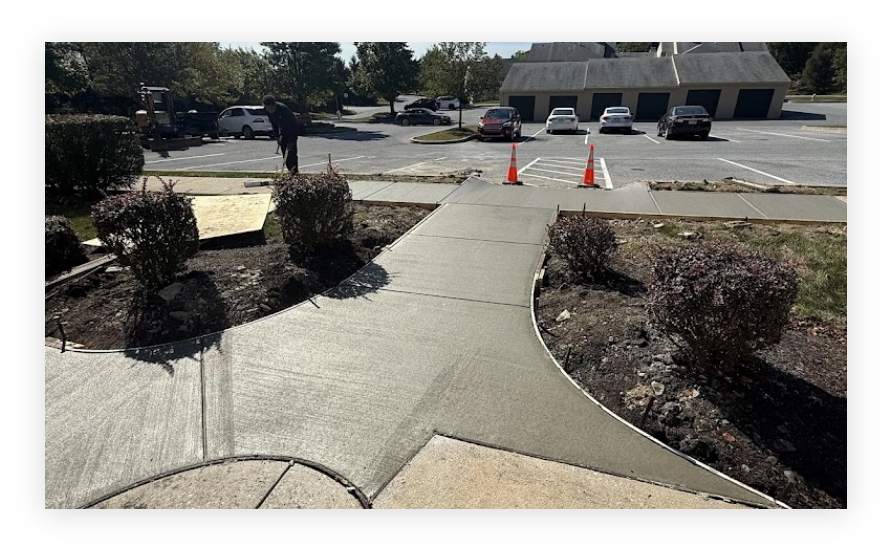
Sidewalk replacement is one of the most common jobs RJL Concrete Service handles around Harrisburg. Homeowners, landlords, and business owners often call with the same questions: How thick should a concrete sidewalk be? Does this uneven slab need to be replaced? And who is responsible if someone trips? Here’s what we tell our customers.
How Thick Should a Concrete Sidewalk Be?
A standard residential concrete sidewalk is 4 inches thick, poured on a compacted aggregate base. Where a sidewalk crosses a driveway, it usually needs to be 6 inches or thicker to handle vehicle weight. In Central Pennsylvania, sidewalks are commonly 4 to 5 feet wide.
However, your municipality may set its own requirements. “For sidewalks and other projects, we follow the applicable project or municipal specifications rather than using one mix or thickness for every situation,” says Rashaun of RJL Concrete Service.
Width and Control Joints
“Five feet is a desirable width in many applications,” Rashaun explains, “while 4 feet can be used in certain circumstances when passing areas are provided.”
Control joints are the grooves across a sidewalk that tell cracks where to form. RJL commonly places them about every 5 feet, adjusting the layout to fit each sidewalk’s actual size and shape.
Why 4 Inches Works, and When It Doesn’t
Foot traffic is light compared with vehicles, so 4 inches holds up well for a typical walk. Problems start when a sidewalk takes loads it wasn’t built for, such as:
- Cars and trucks crossing at a driveway
- Delivery vehicles or lawn equipment driving on the walk
- A weak or poorly compacted base underneath
When that happens, the slab can crack, sink, or break at the edges, and that’s when trip hazards appear.
Do Central PA Municipalities Have Sidewalk Requirements?
Yes, many do. Pennsylvania townships and boroughs commonly set a minimum thickness, width, and base depth, and often require thicker concrete at driveway aprons. Some reference PennDOT construction standards. For example, Hampden Township requires said sidewalks shall be four feet wide, and four inches deep, and shall be constructed of Portland cement concrete.
Many municipalities also make property owners responsible for repairing the sidewalk in front of their property. Rashaun has seen this firsthand: “We’ve worked in municipalities where property owners have been required to address sidewalk trip hazards.”
Before you build: Requirements vary from one township or borough to the next. Always check with your local municipality about permits, ordinances, and standards before replacing a sidewalk.
Sidewalk Trip Hazards and Liability
A raised or sunken slab can do more than look bad. “These hazards can create significant liability and repair costs, so addressing them before someone gets hurt is important,” Rashaun says.
Signs your sidewalk may need repair or replacement:
- One slab sits higher or lower than the next
- Several sections have become uneven
- Wide or spreading cracks
- Crumbling or flaking surfaces
- Water pooling on or beside the walk
Repair or Replace?
Grinding down a raised edge can work for minor cases. However, “if a sidewalk has significant vertical displacement or multiple areas have become uneven, replacement is often the better long-term solution,” Rashaun explains.
RJL doesn’t use one height difference as an automatic rule. Instead, the right fix depends on the cause, how much the slab has moved, its overall condition, drainage, and any accessibility requirements.
Common Sidewalk Failures and How to Prevent Them
Tree Roots
Tree roots are a leading cause of lifted sidewalks. Rashaun’s advice: fix the cause, not just the concrete. “If tree roots are lifting the sidewalk, we evaluate the situation and determine what can safely be done,” he says. Depending on the roots’ size and location, that may mean adjusting the sidewalk layout, addressing roots where permitted, or bringing in an arborist.
Good news for tree lovers: “Tree removal is not automatically necessary and should be evaluated case by case.”
Settling and Collapse
Sidewalks sink when the base underneath washes out or was never properly compacted. To prevent this, keep downspouts pointed away from the walk and fix drainage problems early.
Freeze-Thaw Damage
Central PA’s winters bring repeated freezing and thawing. Water that gets into cracks and joints expands as it freezes, which can widen cracks and cause surface scaling.
Winter Care for Concrete Sidewalks
- New sidewalks: Avoid de-icing salts during the first winter. Use sand for traction instead.
- Existing sidewalks: Use de-icers sparingly and follow the label directions.
- Never use: Products containing ammonium nitrate or ammonium sulfate, which attack concrete.
- Shovel early: Clearing snow before it packs down means you’ll need less product.
Tips to Extend the Life of Your Sidewalk
- Seal the concrete periodically.
- Fill cracks while they’re small.
- Keep vehicles and heavy equipment off the walk.
- Watch nearby trees for signs of lifting.
- Keep water draining away from the slab.
Get a Free Sidewalk Estimate
Whether you’ve received a notice from your municipality or just want to fix a trip hazard before someone gets hurt, RJL can help. We handle residential, commercial, and ADA-compliant sidewalk work throughout Harrisburg and Central PA. Call 717-686-2482 or request your free estimate online today!
About RJL Concrete Service:
Rashaun Hill is the owner and operator of RJL Concrete Service, a locally owned and operated concrete contractor serving Harrisburg and Central Pennsylvania. For the past 9 years, Rashaun has specialized in residential, commercial, and industrial concrete. His work includes driveways, sidewalks, patios, steps, foundations, and garage floors, as well as parking lots, loading docks, dumpster pads, and ADA-compliant sidewalks and ramps.
On every job, Rashaun & his team focus on what lasts: proper base preparation, the right thickness for the load, and honest pricing based on what the concrete project actually needs.
PA Home Improvement Contractor Registration #PA213077 · Fully Insured