Concrete Thickness Guide 101
“How thick does concrete need to be?” is one of the most common questions RJL Concrete Service hears from homeowners and businesses around Harrisburg. The honest answer is that it depends on what the concrete will carry. Below are the typical starting points, plus what we look at before we commit to a number.
How Thick Should Concrete Be? Quick Reference
| Project | Typical Thickness | Notes |
|---|---|---|
| Sidewalk | 4 Inches | Thicker where it crosses a driveway; follow municipal specs |
| Patio | 4 Inches | Thicker for hot tubs, masonry kitchens, or fireplaces |
| Residential driveway | 6 Inches or More | 7–8 inches for campers, large trucks, or equipment |
| Driveway Apron at a Sidewalk | 6 Inches or More | Often set by the township or borough |
| Commercial Pads (Dumpster, Truck Areas) | 6-8 Inches or More | 8 inches for heavy-duty areas |
| Foundations | Engineered | Set by building code and project plans |
These are starting points. “Thickness should be determined by anticipated loading, subgrade conditions, drainage, reinforcement or structural design, and applicable specifications, not simply by choosing a standard number,” says Rashaun of RJL Concrete Service.
Concrete Sidewalks
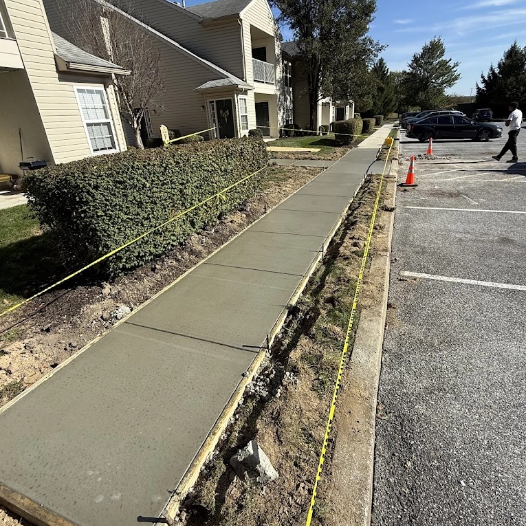
Sidewalks carry foot traffic, so 4 inches is standard for most residential walks. However, many municipalities set their own requirements for width, thickness, and jointing. As a result, RJL follows the applicable project or municipal specifications rather than one approach for every job. Learn more in our guide: How Thick Should a Concrete Sidewalk Be in Central PA?
Concrete Patios
For typical pedestrian use, a 4-inch patio slab is common. That changes when something heavy will sit on it.
“If an outdoor kitchen includes a masonry structure, fireplace, or other substantial load, the slab design may need to be different,” Rashaun explains. “We look at the actual application rather than automatically using the same thickness for every patio.” Planning a hot tub or a stone fireplace? Mention it during your estimate so the slab can be designed for it.
Concrete Driveways
Most residential driveways in Central PA should be 6 inches thick on a compacted aggregate base. For campers, large trucks, or heavy equipment, RJL may recommend 7 to 8 inches. Read the full breakdown: How Thick Should a Concrete Driveway Be in Central PA?
Garage Floors and Commercial Slabs
Residential Garage Floors
Garage floors carry vehicles, so thickness and base preparation matter here too. RJL sizes each garage slab based on the vehicles and equipment it will hold.
Loading Docks, Dumpster Pads, and Truck Areas
Commercial concrete takes a beating from heavy trucks, dumpsters, and concentrated loads. For these areas, RJL typically recommends 6 to 8 inches or more. For especially heavy-duty spots, 8 inches may be more appropriate. Dumpster pads are a classic example: a loaded dumpster and the truck that lifts it put serious stress on a small area.
Foundations
Foundation slabs and walls are a different category. Their thickness is set by building code, soil conditions, and the project’s plans, not by a rule of thumb. RJL works from the project specifications on every foundation job.
Concrete Strength (PSI) and Other Durability Factors
Thickness is only one part of a long-lasting slab. RJL commonly uses 4,000 PSI concrete for residential flatwork, depending on the application. PSI (pounds per square inch) measures how much compressive force cured concrete can handle.
Still, Rashaun is quick to point out that “strength is only one part of durability.” These factors matter just as much:
- Subgrade and base preparation: A compacted base prevents settling.
- Air entrainment: Tiny air bubbles help concrete survive Central PA’s freeze-thaw cycles.
- Control joints: Planned joints give cracks a place to form.
- Finishing and curing: Proper curing helps concrete reach its full strength.
- Drainage: Standing water shortens concrete’s life, especially in winter.
Why Some Contractors Pour Thinner
When comparing estimates, it helps to know where corners get cut. “Sometimes a contractor may reduce thickness to lower the initial project cost or make a bid more competitive,” Rashaun says. “Another issue we see is attempting to install new concrete over an inadequate existing surface instead of addressing the underlying problems.”
That’s why RJL takes a different approach: “We believe it is important to price the project based on what the concrete actually needs, not simply make it cheaper by reducing thickness or preparation.”
Tip: When you compare bids, ask each contractor for the slab thickness, base depth, PSI, and reinforcement in writing.
Check Local Requirements Before You Pour
Townships and boroughs often set minimum standards for sidewalks and driveway aprons. In addition, foundations require permits under the building code. Always confirm requirements with your local municipality before starting a concrete project.
Not Sure What Your Project Needs?
RJL Concrete Service serves homeowners, businesses, contractors, and municipalities throughout Harrisburg and Central Pennsylvania. Call 717-686-2482 or request a free estimate, and we’ll recommend the right thickness for your project.
About RJL Concrete Service:
Rashaun Hill is the owner and operator of RJL Concrete Service, a locally owned and operated concrete contractor serving Harrisburg and Central Pennsylvania. For the past 9 years, Rashaun has specialized in residential, commercial, and industrial concrete. His work includes driveways, sidewalks, patios, steps, foundations, and garage floors, as well as parking lots, loading docks, dumpster pads, and ADA-compliant sidewalks and ramps.
On every job, Rashaun & his team focus on what lasts: proper base preparation, the right thickness for the load, and honest pricing based on what the concrete project actually needs.
PA Home Improvement Contractor Registration #PA213077 · Fully Insured